Psychotherapy as Epigenetic Medicine: A Commentary on Emerging Evidence

Downloads
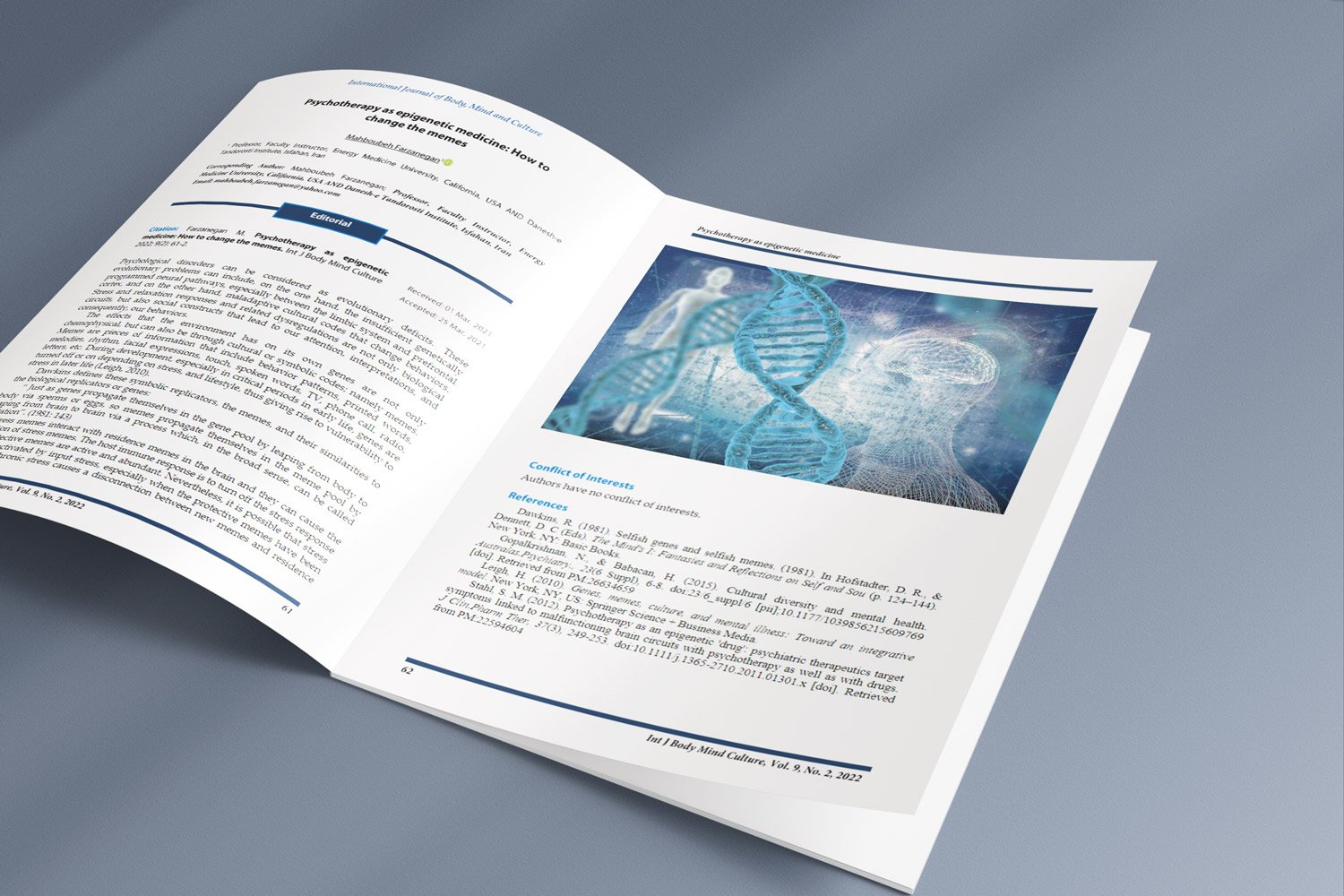
Farzanegan’s (2022) editorial introduces the concept of psychotherapy as “epigenetic medicine,” proposing that therapeutic interventions can modify underlying mental and cultural patterns (“memes”) with potential biological effects. This commentary contextualizes the editorial within current research on epigenetic mechanisms and neuroplasticity in mental health treatment. Evidence indicates that epigenetic processes influence gene expression and neuroplasticity, contributing to recovery from mood disorders and major depression. Psychotherapy has also been associated with measurable epigenetic changes, although variability across therapeutic modalities presents challenges for empirical investigation. While preliminary findings are promising, further research is needed to identify specific epigenetic biomarkers corresponding to distinct psychotherapeutic interventions. Bridging psychotherapy, neuroscience, and molecular biology could advance mechanistic understanding and improve clinical outcomes.
Downloads
Cuijpers, P., Karyotaki, E., Weitz, E., Andersson, G., Hollon, S. D., & Van Straten, A. (2014). The effects of psychotherapies for major depression in adults on remission, recovery, and improvement: a meta-analysis. Journal of Affective Disorders, 159, 118–126. https://doi.org/10.1016/j.jad.2014.02.026
Czarny, P., Białek, K., Ziolkowska, S., Talarowska, M., & Śliwiński, T. (2021). Epigenetics in depression. In The Neuroscience of Depression (pp. 3–13). Elsevier. https://doi.org/10.1016/B978-0-12-817935-2.00029-5
DeCarolis, N. A., & Eisch, A. J. (2010). Hippocampal neurogenesis as a target for the treatment of mental illness: a critical evaluation. Neuropharmacology, 58(6), 884–893. https://doi.org/10.1016/j.neuropharm.2009.12.013
Farzanegan, M. (2022). Psychotherapy as epigenetic medicine: How to change the memes. International Journal of Body, Mind and Culture, 9(2), 61–62. https://doi.org/10.22122/ijbmc.v9i2.429
Hayes, S. C., Strosahl, K. D., & Wilson, K. G. (2011). Acceptance and commitment therapy: The process and practice of mindful change. Guilford Press. https://psycnet.apa.org/record/2012-00755-000
Kays, J. L., Hurley, R. A., & Taber, K. H. (2012). The dynamic brain: neuroplasticity and mental health. The Journal of neuropsychiatry and clinical neurosciences, 24(2), 118–124. https://doi.org/10.1176/appi.neuropsych.12050109
Kroflin, K., & Zannas, A. S. (2024). Epigenetic Regulation in Psychosomatics and Psychotherapy. American Journal of Psychotherapy, 77(4), 173-179. https://doi.org/10.1176/appi.psychotherapy.20230061
McGowan, P. O., & Kato, T. (2008). Epigenetics in mood disorders. Environmental Health and Preventive Medicine, 13(1), 16–24. https://doi.org/10.1007/s12199-007-0002-0
Menke, A. (2013). Gene expression: biomarker of antidepressant therapy? International Review of Psychiatry, 25(5), 579–591. https://doi.org/10.3109/09540261.2013.825580
Stahl, S. M. (2019). Biological Psychiatry and Psychopharmacology. Psychobiology of Behavior, 397. https://doi.org/10.1007/978-3-030-18323-3_13
Syed, S. A., & Zannas, A. S. (2021). Epigenetics in psychotherapy. In Epigenetics in psychiatry (pp. 701–709). Elsevier. https://doi.org/10.1016/B978-0-12-823577-5.00015-5
Wells, A. (2002). Emotional disorders and metacognition: Innovative cognitive therapy. John Wiley & Sons. https://doi.org/10.1002/9780470713662
Copyright (c) 2026 International Journal of Body, Mind and Culture

This work is licensed under a Creative Commons Attribution-NonCommercial 4.0 International License.